Guide
How to choose a Garmin watch face for running
Here is the thing that surprises people: your watch face is not what you look at while you run. The moment you start an activity, the watch switches to your activity data screens, and the face disappears until you finish. Choosing a "running watch face" is therefore not about pace and splits at all — it is about the other 23 hours, when the face is the thing that tells you whether today is a training day and whether your body agrees.
That reframing makes the decision much easier.
What actually belongs on a runner's dial
Something that answers "should I run today?"
Body Battery, or resting heart rate, or sleep. One number that reflects recovery rather than performance. If you check nothing else before a session, check this one, and put it where your eye lands first.
Progress towards something
Steps against a goal, weekly intensity minutes, distance for the day. Runners underestimate how much of training load is accumulated outside sessions, and a ring that is visibly short at 6pm changes behaviour in a way a spreadsheet does not.
Battery, honestly displayed
Not because you are worried about the watch dying at your desk, but because a long run needs a charge the night before. A percentage with days remaining is worth more than a small icon.
The time, bigger than you think
You will read the time more often than everything else combined. If the hours are the same size as the step count, the face has its priorities wrong.
What does not belong there
- Pace. There is no meaningful pace when you are standing still. It belongs on your activity screens.
- Last activity summary. Interesting once, then stale for six days.
- Nine metrics of equal weight. A dial where everything is the same size is a dial where nothing is legible. You will stop reading all of it.
- Pulse ox. An interesting number, rarely an actionable one, and usually hours old by the time you glance at it.
Legibility beats information
A running watch face is read in bad conditions: bright sun, moving arm, sweat on the lens, eyes that have been staring at a road for an hour. Two things matter more than which metrics you chose.
Contrast. Light text on a black dial, with colour reserved for the one or two things that need to stand out. Mid-grey text on a dark grey background looks sophisticated in a product shot and is unreadable at a jog.
Size hierarchy. A quick test before you commit: put the watch on, stand up, and look at it for half a second — genuinely half a second, then look away. What did you retain? If the answer is "nothing" or "I had to hunt for the time", the layout is not working, no matter how good it looks up close.
The AMOLED question
Most current Garmin running watches use AMOLED displays, and that changes two things for a runner.
Always-on costs battery. If you leave the screen always-on, expect meaningfully less battery life, and plan long runs around it. See what actually drains a Garmin battery for the detail.
The dimmed layout matters. In always-on mode the face is redrawn in a dimmed, reduced form. Check what a design dims to before you commit to it — if its always-on layout is an afterthought, you will be looking at that afterthought all day.
On a MIP display, neither problem applies, and the trade-off runs the other way. The MIP vs AMOLED guide covers which suits which kind of runner.
Configurable beats perfect
The single most useful property of a watch face is that you can change what its cells show. Your training changes; a marathon block and an off-season want different numbers on the dial. A face whose fields are fixed is a face you will replace in six weeks.
Check, before buying, that the metrics are choices rather than decoration — and specifically that they can be changed to something your watch actually measures. Altitude and floors need a barometric altimeter, which not every running watch has; what the data fields mean sets out which metrics depend on which sensor.
A sensible way to choose
- Decide on the one number that should be biggest after the time.
- Pick two or three supporting numbers, not eight.
- Wear the candidate for a few days — any face worth buying will have a trial — and notice what you actually look at.
- After a week, whatever you have never once read should be replaced with something you would.
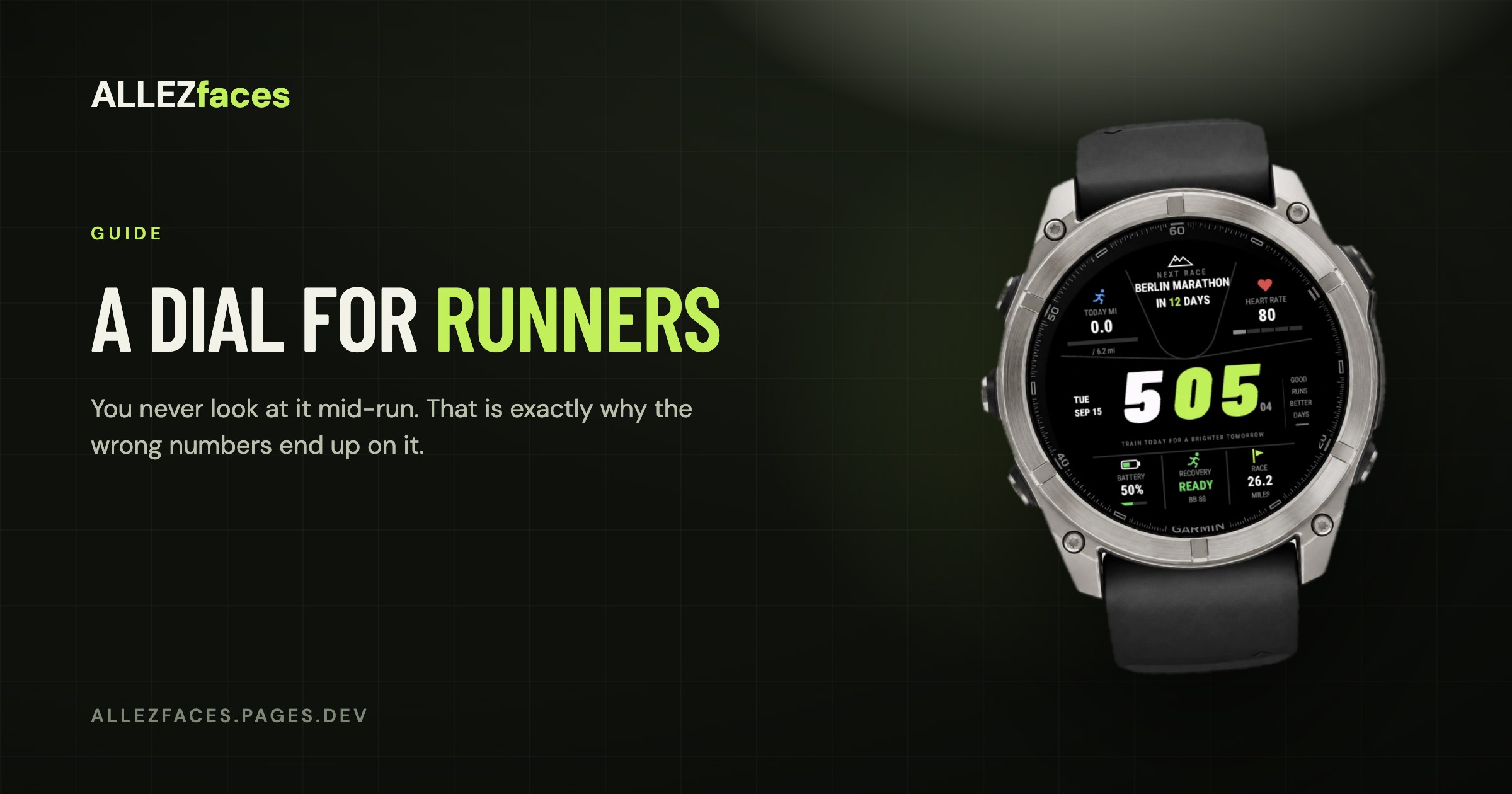
If you want a starting point from our own collection: PACE is built around a race countdown and heart-rate zones for people in a training block, and ENDURANCE strips the dial back to time, battery, heart rate and steps for people who would rather not think about it at all. Both run free for seven days, which is the only review that counts.
Eleven watch faces, one licence each
Every ALLEZfaces design runs free for 7 days on your own watch, so you can see it on your wrist before you decide.
See the collectionUSD 4.99 once per design · no subscription · works on 50 Garmin models